The latest Home Office release on the use of police powers under the Terrorism Act (TACT) 2000 reveals a modest increase in the relatively low numbers of section 43 stop-searches.
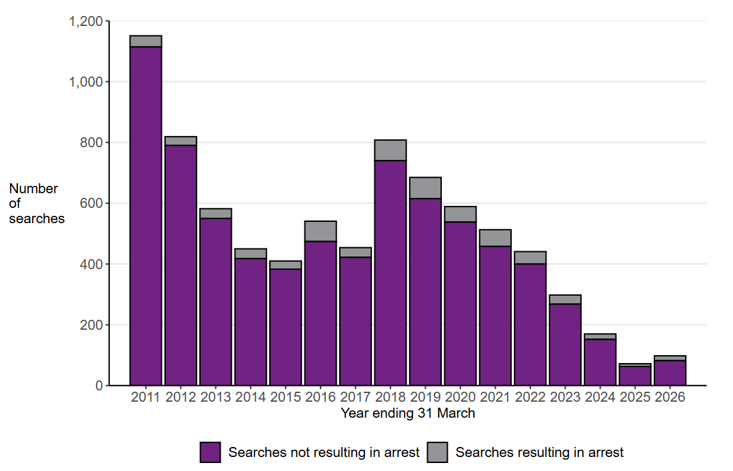
In the year ending 31 March 2026, 98 persons were stopped and searched by the Metropolitan police under section 43 of TACT 2000, +36% compared with a total of 72 persons the year before. It is the second lowest number of persons searched under the power since data collection began in 2011. The number of persons stopped and searched by MPS has decreased by 91% over the period.
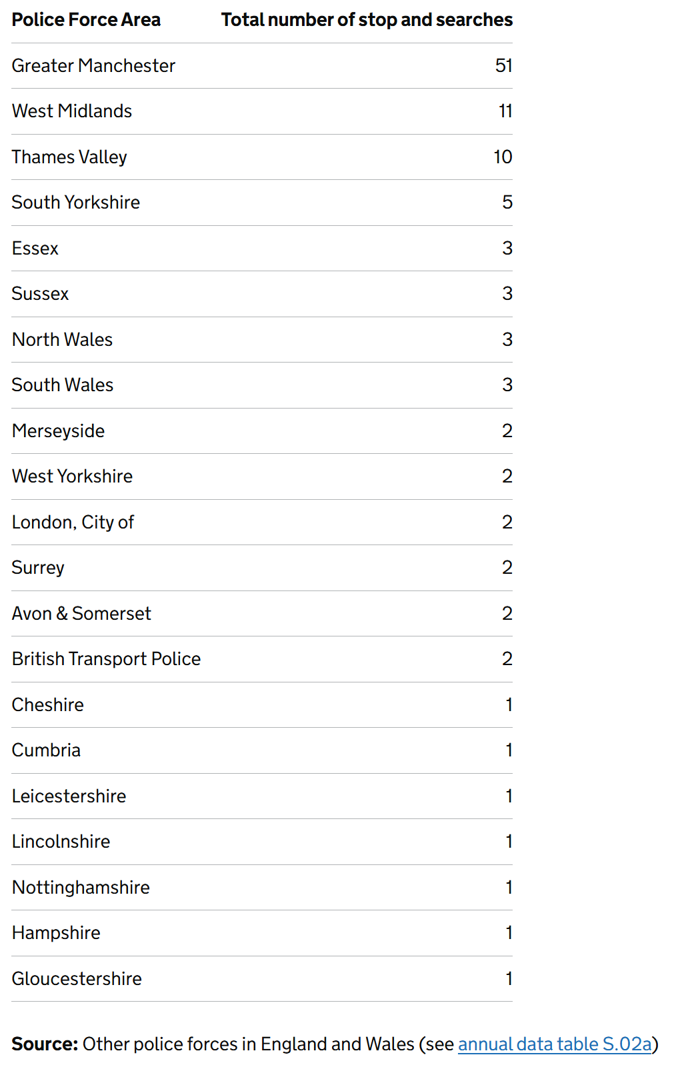
A further 108 persons were stopped and searched by other police forces in England and Wales under section 43, according to the Home Office. Greater Manchester police made most of those searches (51).
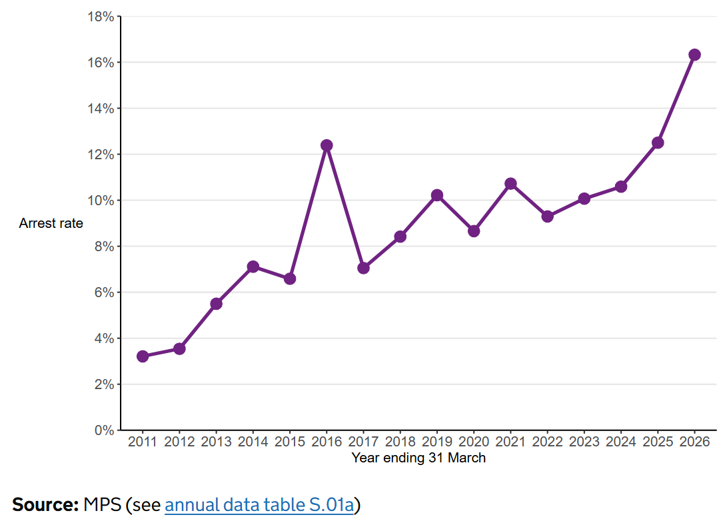
Anti-terrorism police activity focused on executing the orders of a government ideologically driven to proscribe activism in support of direct action group Palestine Action in July 2025, resulting in a 1,186% increase in annual arrests under terrorism legislation. Compared to confronting protestors, the number of arrests that came directly from searches under terrorism legislation remained small. The Home Office reports that 16 people (16% of the 98 persons searched by the Met under section 43 of the TACT 2000 in the year ending 31 March 2026) were arrested, +7 on the previous year. This is the highest arrest rate for year ending March data, since comparable records began (year ending 31 March 2011), albeit from relatively low search numbers.
Other police forces in England and Wales made a further 22 arrests from section 43 stop-searches.
Ethnic identity missing in nearly half of section 43 searches
Missing ethnicity data continues to prevent us from gaining a full picture of persons searched under section 43 TACT 2000 powers.
Ethnicity was stated in only 55% of s43 stops (54 of 98) by Met officers in the year ending 31 March 2026, a lower proportion compared to the year ending 31 March 2025 (42 of 72, 58%). The proportion of cases where ethnicity was known was at its highest at 93% in the year ending 31 March 2011 and has declined ever since. The Home Office statisticians write:
This information relies on the individual stopped being willing to define their ethnicity and the officer recording it accurately.
For the Met, in cases where the ethnicity was known:
- 37% identified as ‘Asian or Asian British’
- 28% identified as ‘White’
- 20% identified as ‘Black or Black British’
- 13% identified as ‘Arab or other’
- 2% identified as ‘Mixed’
For all other police forces in England and Wales, ethnicity was stated in 81% of stops (88 out of 108) in the year ending 31 March 2026. In cases where ethnicity was known:
- 35% identified as ‘Asian or Asian British’
- 26% identified as ‘White’
- 22% identified as ‘Arab or other’
- 11% identified as ‘Black or Black British’
- 6% identified as ‘Mixed’
Schedule 7 examinations: more biometric markers taken
There was an uptick in activity under schedule 7 of the TACT 2000 (involving examinations of persons travelling through UK ports). In the year ending 31 March 2026, 2,714 examinations were made of people passing through United Kingdom ports, +13% compared with the year before (when 2,394 examinations were made). Just over half (53%) of examinations made under the power resulted in at least one biometric identifier being taken from an individual (1,436 persons out of 2,714 examinations).
Relative to this, very few strip searches took place (8 in the 12 months to 31 March 2026), but still more than the year before (when only 3 strip searches took place).